Bloomberg - Forget Doha, Oil Demand Could Create Another Super-Cycle by 2030
While talks among major producers to cap oil output in Doha fizzled,
investment advisory firm Sanford C. Bernstein & Co. sees a silver
lining: growing demand may bring one more super-cycle that allows
investors to cash in on rising prices.
They’ll just have to wait a decade or so.
Emerging
market economies will increase global oil demand about 1.4 percent a
year through 2020, stronger than the past decade, Bernstein analysts
including Neil Beveridge said in a research note e-mailed today. Demand
will peak between 2030 and 2035, creating a window for one final spike
in prices before the fossil fuel begins its inexorable slide to
irrelevance amid greater fuel efficiency and more electric vehicles.
“We
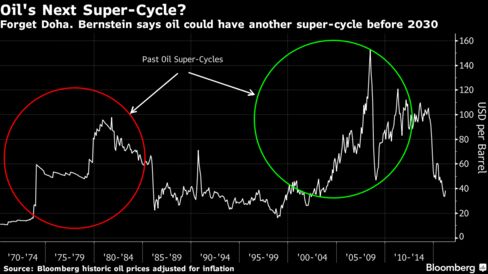
still believe that there could be one more super-cycle in oil before
demand peaks in 2030-35,” Bernstein said in its note. “Assuming tight
oil peaks out before demand does, it could result in another period of
supply tightness as OPEC becomes a dominant force in supply, just as it
did in the 1970s.”
The world is well supplied with oil, which will
keep the average price between $60 and $70 a barrel through the end of
the decade, Bernstein said. The relatively low prices will lead to more
use, with demand growth from 2016-2020 expected to be the highest since
2001-2005.
Energy Efficiency
Oil on Monday posted the
biggest intraday drop in two months after output talks between producers
ended without any agreement on limiting supplies. Saudi Arabia has said
it wouldn’t restrain its production without commitments from other
major producers including Iran, which has ruled out freezing for now.
Emerging
economies will spur global oil demand growth from 94.6 million barrels a
day last year to 100 million by 2020 and 108 million between 2030 and
2035. In developed countries, crude demand is beginning to shrink amid
improvements in energy efficiency and as consumers switch to alternative
fuels, outweighing expanding populations and economic growth.
If
U.S. shale oil production peaks before demand does, the world will have
to go back to higher cost oil production, such as deepwater and
Canadian oil sands, necessitating higher prices to justify investment.
In previous super-cycles in the 1970s and 2000s, inflation-adjusted oil
prices rose about tenfold, Bernstein said.
In the long run, oil
demand will peter out to about 20 million barrels a day by 2100 as the
world becomes more energy efficient and switches to lower-carbon energy
sources. As that happens, the intensity of oil decreases and economic
growth no longer creates crude demand growth.
“At early stages of
development, oil intensity increases in the transition from agriculture
to manufacturing,” Bernstein said in the note. “As countries become
wealthier, more urbanized and more services-led, their oil intensity
decreases.”

No comments:
Post a Comment